
Vaughan Roberts, Rector of St Ebbe's Church, Oxford, and Director of the Proclamation Trust
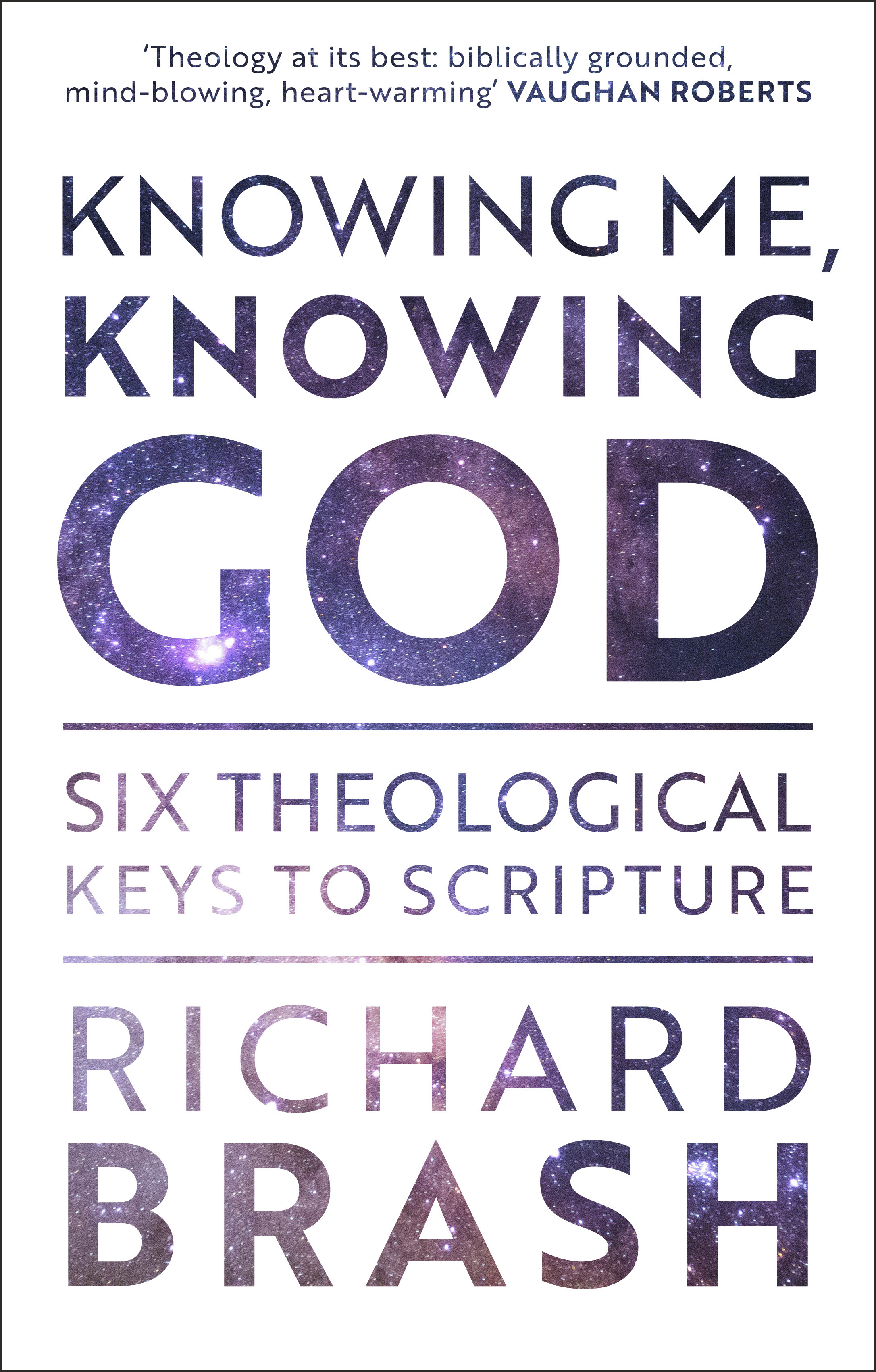
Knowing Me, Knowing God: Six Theological Keys to Scripture
In the Bible, God gives us knowledge of himself and of ourselves, so that through these two intertwined strands we may receive what Calvin called 'true and sound wisdom'. In pursuit of this wisdom, many Christians have learned to interpret Scripture chrono-logically, following the Bible's developing story from creation, through fall, to redemption, and ultimately to restoration. But what of a complementary theo-logical approach to Scripture, one which focuses on the Bible's main 'characters' — God and human beings — and the nature of their relationship?
Richard Brash presents such an approach, introducing six theological keys to Scripture which help us better to know God and ourselves in the three fundamental areas of being, knowing, and acting. At each stage, he develops the theme of the gracious condescension of the infinite, incomprehensible, and holy God in his relation to finite human beings: creating us as his image, establishing a proportion between his own knowledge and ours, and overcoming sin to take a people for himself through the love-gifts of his Son and his Spirit.
If you are looking for an enlarged vision of God and a renewed understanding of your own vocation before the Lord, take up this book and be refreshed in your love for God in heart, soul, and mind.
Press Reviews
I don't know of a better introduction to Christian doctrine than this brilliant new book by Richard Brash. It is both modest and ambitious in its aim: not attempting, like a textbook, to cover all the major doctrinal themes, but rather, like a guidebook, seeking to introduce to the territory and point us in the right direction to discover its delights. We are introduced to three deceptively simple pairs of contrasting statements, which together provide a window into the vast vista of biblical teaching, a compass that enables us to navigate the terrain, and a set of keys to help us begin to unlock some of the mysteries we meet along the way. This is theology at its best: biblically grounded, mind-blowing and heart-warming. It is a great resource, both for those who are new to systematic theology and to seasoned travellers. Enjoy the journey!
— Vaughan Roberts, rector of St Ebbe's Church, Oxford, author of God's Big Picture
Winsome and rich, this book wonderfully exhibits the bond between the knowledge of God and of ourselves. Richard Brash gives us a reliable compass to keep us from getting lost in the theological forest.
— Michael Horton, J. Gresham Machen Professor of Systematic Theology and Apologetics, Westminster Seminary California, USA
Many people are wary of 'systematic theology' but it is, when done properly, simply an exercise in reading the Bible as a whole and in fellowship with God's people. Richard Brash shows us how that is so. This simple doctrinal 'compass' will help you navigate life in God's world in the light of God's word. Richard writes with a clarity that comes from knowing the subject well. He enables us to see that the big picture of the Bible is both an unfolding narrative and a coherent account of God and his purpose in creating us, making himself known to us, and saving us from sin. Highly recommended.
— Mark D Thompson, Principal, Moore Theological College, Sydney, Australia
Thoroughly contemporary but at the same time well rooted in exegesis and biblical theology, this volume quickly gripped me as a fresh, stimulating and enjoyable plea for Systematic Theology. But it is more than a plea. Its six keys serve as both invaluable entry-points and as axioms to guide us in life-long study of the relations between one biblical truth and another, and between each truth (or Scripture text) and the whole field of revelation. The keys are well chosen and, being presented in pairs, remind us of the danger of being carried away by one side of a truth at the expense of another. This volume will both feed and stretch your mind, but it will not exhaust it.
— Professor Donald Macleod, Edinburgh Theological Seminary
Knowing Me, Knowing God: Group Study Guide
Richard has written a study guide for Knowing Me, Knowing God, to help leaders of small groups run a series of eight studies based on the book. This is available for free download.
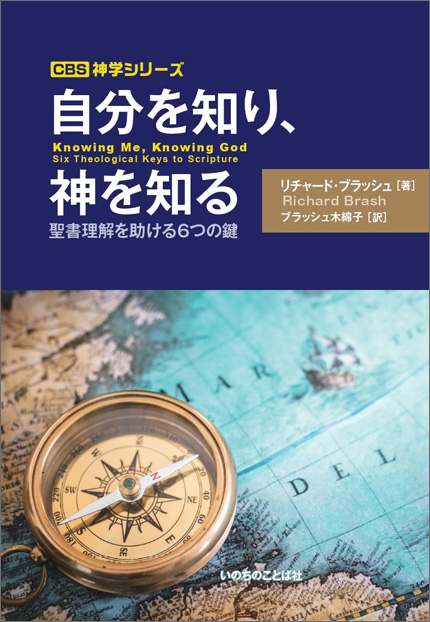
Japanese edition: 自分を知り、神を知る
Knowing Me, Knowing God was translated into Japanese and published in May 2022 by Word of Life Press (いのちのことば社) and CBI Press, with the subtitle 聖書理解を助ける6つの鍵 (“Six keys to help us understand the Bible”).
The publisher describes it like this: through three pairs of seemingly contradictory statements, such as “God is nothing like us” and “God made us in his own likeness”, the book explains what the Bible teaches about God and human beings, tying it to a living relationship with God. Systematic theology, which can seem forbidding, comes much closer to home.
Reviews of the Japanese edition
These two endorsements appear in the Japanese edition. They are translated here from the Japanese.
This is a beautiful book. The author, Mr Brash, likens it to a compass that shows the way when we walk through the deep forest of the Bible. As we make our way into the Bible's rich world like this, the book unravels six riddles. In the unravelling, two statements that seem contradictory are set side by side as a pair, and as each is “wonderfully” joined to the other, the book draws a “big picture”. That picture shows that “knowing God” and “knowing human beings” are inseparably bound together, and it becomes a voice of encouragement to us as we live our lives. This book is an introduction to systematic theology. Anyone who has the impression that “systematic theology is dry and dull” will find that impression splendidly overturned. It is that readable, and yet rich and deep. Readers will have their eyes opened to see that “knowing God and human beings” is the way that gives us courage to live. And with the sense after reading that “life is worth living”, they will meet the God who encourages us with his Word.
— 齋藤五十三, Associate Professor of Systematic Theology, Tokyo Christian University
I wholeheartedly recommend this book. It is an introduction to systematic theology with blood flowing through it. Many books make “systematic theology” sound forbidding; this one is different. There is, of course, a proper fear of the “holiness” (Isaiah 6:5) found in God himself and in Scripture, but in many respects this is an introduction that puts the reader first. It is not the kind of introduction that draws you in and then disappoints. A kind of rite of passage into the world of systematic theology (getting used to many technical terms and close logic) is necessary, but the author does not forget to explain the “Big Words”, and takes care in various ways that the argument does not run ahead of the reader. The structure is surprisingly clear. Two biblical theological ideas that seem to oppose each other are set against one another (three such pairs in all), so that the reader can follow the individual arguments while seeing the whole. Biblically, the interpretation and citation of Scripture is appropriate and careful. The quotations are wide-ranging and contain theological wisdom not to be missed, including some related to Japanese culture, which shows that the author stands close to Japanese readers. The book not only teaches and encourages us to do theology biblically; it also makes clear the direction and shape of “what to do theology about, and how”. It is a rare introduction to systematic theology that makes you feel the author is near. In church, the theological questions at the end of each chapter can be used for discussion and sharing. It will lead those of us who are already doing theology as we walk to become a church that does theology better. And if you read the Bible inductively each day on your own, I also recommend this book, so that you read the Bible from the standpoint of the whole Bible. We need to see not only each tree, but the whole forest. I recommend it wholeheartedly.
— 渡辺睦夫, Pastor, Inazawa Christian Church
Author interviews on the Japanese edition
A ten-part video series in Japanese, with English titles added here.